The live show coverage continues in full force here at DaveCromwellWrites. With the first half of this year favoring live performances over new recorded works, that pattern continues here once again. Returning to a venue last visited at the end of 2024, two favorite bands now appeared there for the first time. Having experienced these artists spectacular live shows multiple times at other storied locales, the opportunity now presented itself once more in a unique and well-respected arena.
It was just over a year ago when a show at the House Of Blues in Orlando, FL dubbed “The Goth Prom” was attended. Performing that night (and seeing for the first time) were two of the best Tribute bands on tour. Both Lovesong-The Cure Tribute and Strangelove-The Depeche Mode Experience put on dazzling shows of exceptional interpretation at the highest level. In the 12 months plus that followed, more Lovesong shows would be attended at a number of nearby popular Orlando-area venues. Thrilled to see that *both* bands would be performing together again on June 19th at The Plaza Live made attendance there a must.
Opening the show was the band we've become quite familiar with over the last year. Having caught multiple shows by them all over the Orlando area, Lovesong The Cure Tribute present a stunningly accurate re-creation of that English Goth bands entire catalog of music.
They kicked the night off with one of their most recognizable songs "Just Like Heaven," much to the packed crowds delight.
That was followed by the equally beloved "Inbetween Days" - the whole show was pretty much one Cure hit after another.
With the fan favorite "Pictures Of You" serving as further evidence.
Deeper tracks began to emerge, with the still wildly popular "The Walk"
The moody and mysterious "Fascination Street"
Quirky/cute pop of "Let's Go To Bed"
Trippy fever dream "A Forrest"
Heartfelt angst with "A Night Like This"
An anticipated show highlight was the visually stimulating fire-on-screen projections for "Burn." Robert Smith and peak-era drummer Boris Williams wrote and recorded the track specifically for the 1994 film "The Crow."
Another expected moment was the band playing their namesake composition "Lovesong," which comes complete with romantic video screen images of Robert Smith and his wife Mary.
That was followed by the creepy-cool spider musings of "Lullaby"
Since it was a Friday night, it could have been more appropriate to hear them play "Friday I'm In Love"
They closed out their show with The Cure's first hit and probably most know song "Boys Don't Cry."
There are a number of opportunities to catch Lovesong live in the days ahead.
Getting a second opportunity to see and hear Strangelove-The Depeche Mode Experience on this their 40 years of Black Celebration 2026 World Tour was a thrill once again. With a few back-end personnel changes this time around, there was no loss of quality in both sound and overall performance. Front men Brent and Leo still carry the show, with rock solid drummer Chris (a more live upgrade over electronic beats) and new keyboardist/harmony vocals Kaleb all contribute to a show that the one and only OG Martin Gore says is “such fine detail that's it's scary.”
The show opened with "A Question Of Time," the third single and sixth track on Black Celebration. The visuals of various clocks on the projection screen behind them set the tone for all that followed.
That was followed by "World In My Eyes," an instantly recognizable and wildly popular DM single from their seventh studio album, 1990's Violator.
"Get The Balance Right" was next, delivering a perfect rendition of this 1983 single (and first with Alan Wilder as an official member).
The sometimes maligned "People Are People" from 1984 was delivered with precision. A chart topper at the time, both Martin Gore and Dave Gahan thought the song was ultimately "too commercial" and stopped playing it live in their shows.
Less pop and more in line with darker themes saw the band perform 1985 single "Shake The Disease." Brent leading the audience with his "understand me" vocal is a particularly sublime moment.
Returning to Black Celebration, the moody lead single from that album "Stripped" was played. Sometimes confused with sexual connotations, it's more about stripping away all of your trappings.
A brilliant version of "Halo" from 1990's Violator album.
Brent really puts all his heart and emotion into the tender relationship ballad "A Question Of Lust."
Going back to the early days, 1981's "Just Can't Get Enough" was DM's only 3rd single (and first release in the US), and one of the few to be written by soon-to-be-leaving the band Vince Clarke.
Another early gem, 1983's "Everything Counts" is still so relevant with it's satirical critique of corporate greed.
Since this day was actually Brent's (a/k/a "Counterfeit Martin") Birthday, the guys from Lovesong (and his own band) came out and presented him with a birthday cake, and an audience serenade to him.
The always popular "Policy of Truth" from 1990 album Violator was another show highlight.
As was the deep groove "It's No Good" from 1997's Ultra.
It's always a celebration (black or otherwise) when the tribute band plays their namesake song, as was the case here with "Strangelove."
"Behind The Wheel" is another deep dive into the bands catalogue, from their 1987 album Music for the Masses.
Moving ahead two decades, "Suffer Well" is from their 2005 eleventh studio album Playing the Angel. It was their first single written by Dave Gahan, and first single not written by Martin Gore since the above mentioned "Just Can't Get Enough."
Dipping back into the Ultra catalog, the fourth and final single from that album "Useless" is always a crowd pleaser.
As is the bands most successful worldwide hit "Enjoy The Silence." The Violator track because their highest-charting US single, and has since amassed over a billion streams.
That is rivaled by the other huge Violator single "Personal Jesus." The first release to enter the US Top 40 since 1984's "People Are People," it was also their first gold-certified single in the US.
Closing out the show was live show crowd pleaser "Never Let Me Down Again." A fitting end to a satisfying 20 song concert, leaving everyone buzzed by the incredible audio and visual experience.
A hand signed setlist always a treasured keepsake.
Pre and Post Show chit chat were the order of the day, engaging with our favorite usher Natalie (we see her at Hard Rock Live all the time as well) and of course two of the Strangelove superstars.
Lovesong's Nick Bomleny is always great to catch-up with.
All the fun of the fair.
Recognition for the positive Florida turnout.
The tour rolls on throughout the summer.
Including a number of dates continuing "Love Is Strange" with Lovesong.
A new year and new locations provide the backdrop for this month’s DaveCromwellWrites Feature. Introductory singles from new artists on the cusp of releasing their debut full-length share space with returning artists who’ve previously received deep-dive reviews. The collective result are audio journeys encompassing a wide range of fuzzy dream pop, dynamic changes, progressive electronics, improvisational recording, along with a more precisely structured indie pop.
Hearing that fuzzy-gaze dreampop band Phantom Wave are preparing to release a new full-length LP “Bonfire Secrets” in the coming days is exciting news. Having met the band last year at a Ringo Deathstarr show, it comes as no surprise they’ve enlisted that bands sonic guru Elliott Frazier to mix those tracks. Diving right into the advance stream provided for review, some thoughts immediately flow from the mind and fingertips.
First single and featured track “First Light” initially floats out of a mist in the most dreamy way. A tom-tom driven drum pattern and measured bass guitar provides movement underneath soft shimmering guitars and clean delivered vocals. That softness is abruptly shattered by following passages of hard charging drums, bass and a wall of guitars. All the while, passionate vocals implore you to “hold out the first light.” Downward driving accents add punchy power under vocals delivered with urgency.
Listen to this slow burn fuzz right here:
Promised next single and album opener “Chimera” comes on quick and a bit poppy. Is that 80’s era Cure? Clearly not once the big noisy hook is reached, as a wall of sheering guitars run roughshod over everything. The bass guitar is busy, providing melodic movement, while the drums thrash and bash their way throughout. Vocals are soft and conversational. Is it about a grotesque monster having disparate parts? An apparition, dream, illusion or vision? Who knows – it sounds fantastic, though!
The full “Bonfire Secrets” album is currently scheduled for an April 2024 release.
Keep up with Phantom Wave via their Social Media for updates and new release info.
* * * * *
Back in July of 2021, DCW did a deep-dive review of the San Diego-based research and development collective Corduroy Institute and their musical duo’s full-length album “Eight/Chance/Meetings.” That creative outlet is now back with a new long player “Take the Train to Manchester.” Consisting of 9 new compositions created between December 2019 and August 2023, this intermittent crafting is the longest span of time spent on any of their albums. Once again using their institutional methodology of cut-up lyrics pulled from print media, the music was created through multi-tracked improvisations.
Opening instrumental track “Take the Train to Manchester” emerges slowly from an electronic substation. Train track-like clack percussion gives weight to the theme, before submerging behind ominous synth pulses and forward driving bass guitar. That percussive clack returns and is joined by higher pitched synth textures. It feels a bit like early Kraftwerk and their pre-mechanized “Trans Europe Express.”
First vocal song “[A] Girl Named Philosophy” moves along mysteriously, adding subtle twangy guitar lines over a deep thump bass and percussion. It’s fascinating how a full story can be conjured together with found, cut-up lyrics. Vocals are delivered with a resonant baritone, while closing lines “in a deal with absurdity” suggests more “folly” than actual “philosophy.”
“Say Something Gentle” brings back the clacking, train-like percussion, enhanced by solid bass guitar and filigree brighter-toned six-string figures. Vocals are dispatched now in a higher pitch, closer to a tenor. Horns (or the synth approximation) are an added element, with repeated lyrical line “the true colors of the machine” standing out. The title line eventually appears with the composition reaching it’s conclusion.
An angular bass guitar pattern provides the musical structure for next cut “Uncirculated Knowledge of the Universe.” Dueling vocals appear throughout, adding to it’s overall ethereal feel. Both vocalists present those cut-up lyrics frequently in echo-repeat fashion. “She can do whatever she wants” serves as one focus vocal line. “(An) Intimate (Tension)” bubbles up ominously via violin-like strokes and stressed textures. A slowly descending bass guitar provides the most rudimentary framework for this instrumental only tone poem.
A bright, clicking percussion pattern kicks off next entry “They Don't Even Know.” Long-held keyboard pads lay out a chord structure over distant, driving bass guitar. There’s a soulful, near-funky feel to this one, combining an electric “drums and bass” vibe with a melancholy mood. Completing some kind of thematic arc with the previous cut, “No One Ever Knows” pivots to gentle acoustic guitar for initial instrumentation, while layering on unintelligible tape-recorded voices. A deeper Cello-like texture saws back and forth in a gradually decaying pace that Brian Eno employed on his 1975 masterpiece “three variations on the canon in D major.” This composition is more acoustic guitar-centric, however and the light textures those strings add contrast playfully with those taped found sounds.
“Our Former Places of Worship/Luminous Chaos” combines synth textures, bass guitar, stirring vocals with hiss-crack percussion. Synth chords and bass guitar breaks offer up spaces between vocal line readings. Rising synth textures evoke Eno once again, but this time his early work with Roxy Music. Final entry “You Always Loved Everything…” adds echo to the dual vocal rendering of these particular cut-up lyrics. “I was worried about leaving” followed by the song title. Driving bass guitar, sparse electronic percussion and a smattering of synths all contribute to an overall Joy Division-like feel.
Listen to and find out how to acquire this innovative recording here:
Follow Corduroy Institute on their Social Media: Instagram - Facebook
It’s been a while since new music from Chad Sabo has made it’s way onto this site’s radar. It was July of 2018 when a combined live show and previous release retrospective was covered on his band The Cold Seas at that time. Enjoying a seamless 10 song set comprised of the four singles and one EP released over the previous two years, an appreciation for the talent on display was realized.
Now Chad is back with his debut solo album “joyride,” inspiring a new DCW deep-dive review.
Choosing to open the album with an amusing short “intro” of upbeat electronic rhythms and spoken word, Chad invites the listener to join him “on this sonic joyride.” That leads into the albums title track which advocates the virtues of going for a cruise in your favorite car. The production is impeccable, with soothing higher pitched vocals that bring to mind high-gloss pop bands like 10CC.
Every instrument is precisely placed, with each percussive and stringed note avoiding excess. Voices are intertwined and pitched to varying levels. Follow-up track “Still Mine” relies on strummed guitar for rhythm, adding off-kilter ambient instruments for oddball effect. Lyrics “saw your name pop up on my Instagram – I know that face well” references the way we sometimes carry on relationships via the internet only. “Sunday” doubles down on the warbly strummed guitar, adding a funky bass pattern and soulful background vocals. “I’m no good for love (pronounced LA-ove)” is the essential lyrical refrain. Sweet, sentimental roller-rink style keyboards completes the audio picture. “Catholic” morphs over to dreamy with a Beatles-esque vocal cadence, and well-placed tambourine accents. Dealing with embedded influences, lyrics “I don’t know if I believe in something greater – or at least myself,” questions early religious training.
“Holy Ghost” seems to hold onto the previous theme, while pivoting to other potential sonic influences. The in-your-ear, casual spoken word style employed so effectively by The Strokes is noticeable, as are those choppy guitar rhythms and single run melodic fretwork lines. Clever lyrics provide strength behind the whimsical musings of “Our Love.” Understated guitars and a driving bass offer up the appropriate accompaniment for witty rhymes like “just look at us – making out in our electric chairs – and the coroner said he the saw sparks come flying from our hair.”
“Another Show” laments being “too hung up to go down easy” but will “hang around till I know your leaving,” making this “show” about a failed relationship all too real. Regretting spending time “chasing rainbows in a thunderstorm” furnishes appropriate imagery for time squandered. Bass guitar continues to drive everything throughout the curiously titled “Single Use Plastic.” That title reference becomes clearer with the lyrics “the wind has changed – a thousand ways – a plastic bag caught in the sky.” Points given for the madcap instrumental break at the songs midpoint. In fact, this composition offers up multiple distinct passages, making it one of the more densely constructed offerings here. The album wraps up with a brief "outro" where Chad thanks this listener for "hanging out."
A Feature on this artist previously posted on this site can be found here.
* * * * *
Near the end of 2021, DCW wrote a detailed review of Adam Lippman’s featured single “Sunblind,” from the later released full-length 'Some Things Cast Long Shadows.' That track later earned placement in the year-end “Best Of” annual wrap-up. Adam is now back with a new single “Wasted” which delves once again into the pop-indie-rock genre. Written and performed by Adam, the track was recorded and produced by James Mauri at Strawberry Hill Studios in Norwalk, Connecticut. Showing off his visual arts skills as well, he also painted the album cover.
A spirited snare shot, high-hat and bass drum beat kicks the song off as melodic six-string and bass guitar quickly joins in. Adam’s reedy vocals soon commence, telling the universal tale of how people meet at “the bar right down your street.” A subtle xylophone is detected underneath the following lyrical theme that references the songs title – how so much time can be “wasted” in these pursuits. “When you gonna come around?” is the repeated questioning expressive inquiry and hook. “You didn’t have to run and hide from me” ultimately leads to “we don’t have to look too far to see that it’s wasted.” At the tracks midway point the rhythm guitars and bass drop back leaving percussion and more open spaces. An ambient descending guitar texture and simple bass lead the way to a pleasing rhythmic interlude, before repeating the primary vocal hook, leading to its overall conclusion.
Listen in and find out how to acquire this track here:
A combination of innovative original instrumental music focusing on keyboards and guitar serve as the primary entry point for this month's DaveCromwellWrites Feature. As this site continues to evolve, a greater appreciation for musicians composing and recording works that focus on art over repetitive commercial pursuits grows exponentially. That said, when a quality pop song emerges out of the seemingly endless sea of replication, that too will always find a place for close listen and evaluation here.
Holding true to the old axiom of how discovering one artist often leads you to another, Brian Charette finds his way onto this site following last month's deep dive into the music of Oz Noy. Noticing the high-quality, double-tiered Hammond B3 playing he contributed to Noy's “Looni Tooni” made it an easy decision to dig further into Brian's work.
A brand new full-length album “Like The Sun” is set for release on December 1, 2020 that features 13 mostly new original compositions. Recorded during the first months of lock down, these instrumental tracks forge a new hybrid sound that combine electronic beats with the richness of traditional organ sounds.
Opening cut “15 Minutes of Fame” lays out a funky robotic groove with a sharp, synthetic descending keyboard line surrounded by otherworldly textures. Lush, dreamy atmospherics alter the mood in-between in a most pleasurable way, before Brian's improvisational organ soloing commences. What's impressive is how nearly all of this record was recorded live in one take, reacting to random programming changes via the accompanying autogenerated beats and chords.
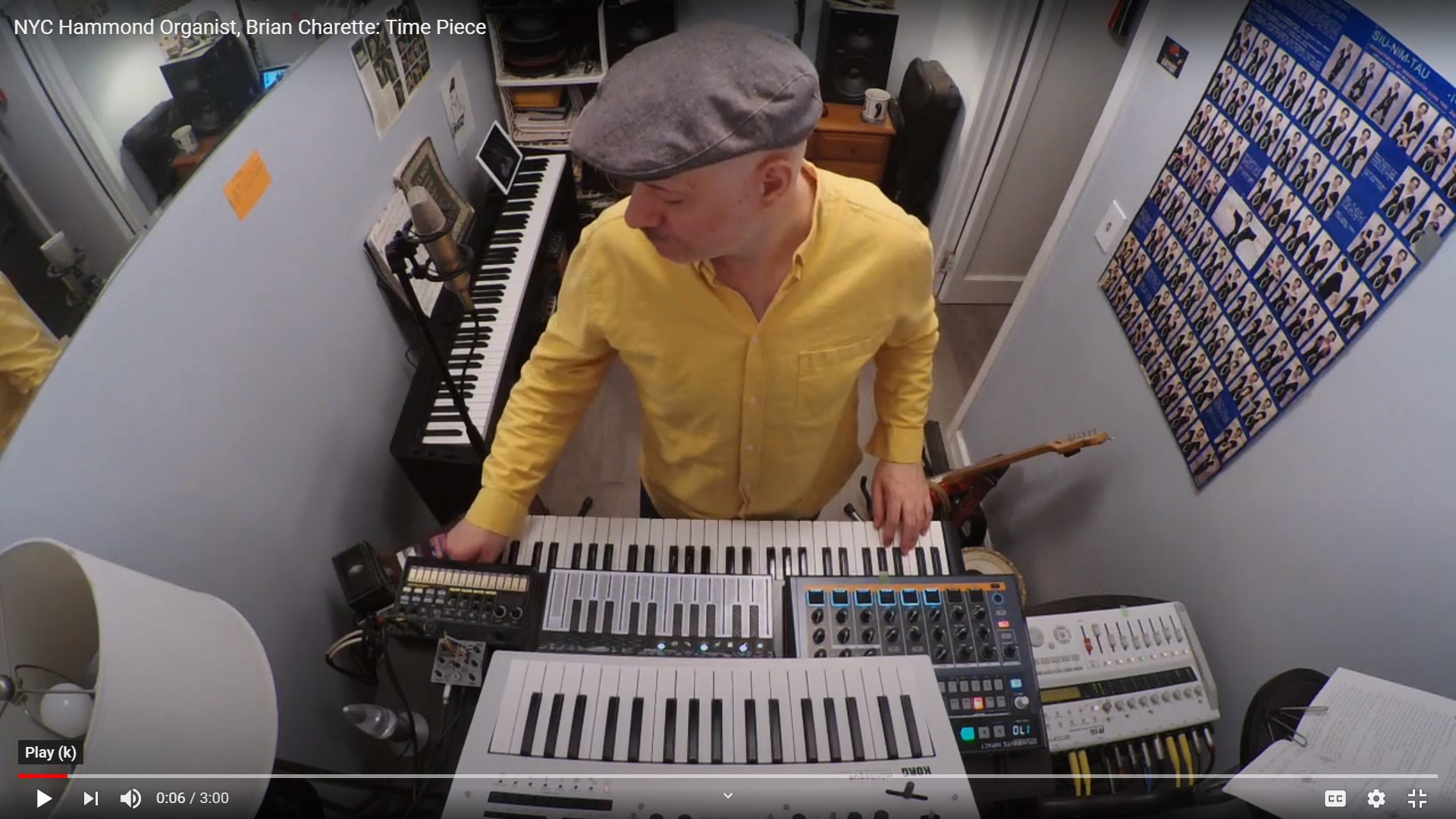
You can see and hear this happening live-in-that-moment via the below video (and 2nd album track) for “TimePiece.” Looking down on Brian's impressive rig of keyboards, samplers, drum machines and tone generators, the composer kicks off a mechanized beat and programmed chord progression. Taking to his highest-point mounted keyboard, sweetly piercing flute-like tones are the first to be played, establishing a central melody. Moving down one level to his mixer, audio samples and percussive bursts are initiated on the spot. As the song enters a defined chord change section, Brian drops to his third-tier down keyboard controller and unleashes some soulful organ improv. Check out this wonderful track here:
Third cut “Slasher” gets right to the warm organ tones, balancing that against slap-trappy percussion. After a minute another more synthetic keyboard texture emerges, providing counter-melodies to the organ running along simultaneously. Ascending otherworldly ambience serves up an appropriate coda.
While “Honeymoon Phase” continues that rough brush-stroke percussion, reverberated electric piano is introduced as a dueling keyboard element against the traditional B3 organ. Additional synthetic textures find their way into the mix as well, however it is the romantic chord selection and emotive playing that really shines through here.
Title track “Like The Sun” hits the ground running in full motion with a busy, angular sequence and syncopated percussive strokes marking out an interesting (and peculiar) pattern. Sampled voices materialize like Middle-Eastern prayer chants, and deep bass notes expand the sonic field into lower regions. Organs, synths, blips and bleeps all make appearances, adding an element of sci-fi to it all. There's even a bit of distorted-voice spoken word narration included in the final minute of this over six minute extravaganza.
Other cuts like “Mela's Cha Cha” position closer to more recognizable jazz-funk-soul hybrids, leaning more on buzzy brass synths for melody phrasing. However, there's always room for a few bars of rich, organ stylings and complimentary “outer space” ambiance.
“Three Lights” blends emotive Hammond B3 organ jamming over top of a hypnotic calypso beat. “Break Tune” takes the beat into a more static direction, with a pattern and sound like a Nine Inch Nails intro. While additional icy synths and distressed vocal samples may also throw off a Reznor-like feel, alternating passages with soulful organ and jazz guitar accompaniment take the edge off any potential existential dread.
“From Like to Love” introduces an even brassier synth as the melody instrument to build everything else around. Jazz inflections are the predominant voicings on chord phrasing while the blues scale is applied to solo forays. “Creole” blends a variety of traditional organs with buzzy brass synths over a funky bass and percussion rhythm. While the bright synth tones Keith Emerson with ELP, the end out jam is pure Brian Auger's Oblivion Express.
The motorik beat and Teutonic rhythm of “7th St. Busker” may be the closest track on the album fitting Brian's own self-description of “Kraftwerk meets Harlem juke joint.” Even the alternating synth textures have a “Trans-Europe Express” feel to them. An unexpected child's voice appears near the very end, adding one more twist to it.
An easy groove organ melody line over clearly defined chord progression introduces “Robot Heart.” Things become more “robotic” further in with an arpeggiated sequence, ice-alien keyboard stabs, high-hat tick percussion and mysterious voice samples. Final track “57 Chevy” builds off a funk heavy beat and three essential keyboard parts. A basic two-chord pattern of reverbed electric piano, soulful organ soloing over top of that, and a change section that features rising chords and low-end percussion.
Overall, this is a truly wonderful instrumental album that delivers a wide compositional and sonic range, perfect for the many moods we all experience throughout the course of each day.
Connect with Brian at his Official Website and Facebook Page for Info on how to acquire this New Album, as well as all his other work.
* * * * *
Musician Afonso Dorido is a Portuguese artist who creates instrumental music under the name Homem em Catarse (which translates to “Man In Catharsis”). Earlier this year he released a 10 track album titled “sem palavras / cem palavras” (in English - “without words / hundred words”) that delves into a heady mix of dreamgaze, ambient, slowcore, classical and emotional musical styles. Primarily a guitarist, this artist also creates on piano, synths, bass-guitar and bits of percussion. The album's producer/mixer also added percussion on a number of tracks, and a string section is used at times as well.
The album opens with a two-minute gentle piano-only rumination poetically titled “You were just a little leaf.” Slow, measured four note arpeggio chords establish an introspective progression, as tender melodies are played on the higher-toned keys.
However, it is with following track “Hey Vini!” that we are introduced to the ambient, psychedelic dreamgaze promised in promotional descriptions. Moving to guitar here, Afonso opens with an electrified diffusive wash, then switching to placid open-note chords. Bringing in percussionist (and producer) Pedro Sousa creates a more solid foundation and complimentary rhythm section with Afonso's additional bass guitar work. The track seems to float on air, with it's multiple layers of reverberation – bringing to mind the dual guitar work of Robert Smith and Porl Thompson on classic-era Cure songs. Returning to that gazey sound only hinted at in the intro, a new layer of extended-tone, quick-strummed, e-bow style guitar textures flood the sonic spectrum, leading out to one more open-note-chord coda.
A pattern of short, steady, plinking sounds introduces “Hotel Saturnyo” as deep, reverberated guitar notes roll out a slower melody over top. Percussion soon enters the mix with additional guitars layering on in a more urgent manner. Using a digital delay on guitar riffs create the sensation of many guitars playing at the same time (something U2's The Edge is famous for), and this technique is employed here as well. The pace is quicker though, with deeper bass guitar moving underneath at a more defined pace. Synth strings arrive to enhance the tracks final minute, adding another majestic layer.
Slow moving guitar twang give fourth cut “I remember yourself when I can't remember” a dreamy western feel, that's part Spanish Classical Guitar and part American Cowboy. Adding a rapid strum layer at mid-point pulls things over into dreamgaze and psychedelic territory.
Sticking with the slowcore premise and progression, “Marie Bonheur” serves up it's glacial pace through double guitar layers of strummed chords and bright guitar figures over top. Carefully paired percussion and bass guitar enters the mix, creating the base for multiple layers of emotional guitar melodies. The final minute adds a gorgeous violin and cello string arrangement lifting it all into the realm of classical.
Returning to solo piano, Afonso presents a lovely progression and melody on “Calle del Amour” (Love Street). There's an almost Christmas feel to this one, with it's stark impressions of a landscape that might possibly play best in the month of December.
Synthesizer pulses, sparse mechanized percussion and bass guitar set the tone for “Yo La Tengo” (I Have It). In contrast, natural electric guitar figures are played with an emotive quality, adding warmth to the proceedings. Guitars progressively occupy the sonic field, converting what began somewhat automated into a more overall organic feel. The addition of chorused voices in the closing moments creates a final uplifting sensation.
Rising up out of silence comes a pizzicato struck guitar pattern on what seems appropriate for a track titled “Martian Dances.” With that rhythm established, a more traditional rock bass-guitar and drum segment commences. Dueling guitars emerge with one playing digital delayed notes and the other rough-hewn textures. A strong melody develops out front, before the rhythm-section drops out, leaving clearly defined guitar notes remaining against the initial pizzicato design. The cycle repeats, leading up to a grand finale finish of guitar pageantry.
Clocking in at over six and a half minutes, “In the Sea” serves as the longest track on the album. As this length might suggest, ample room is provided for extended, ambient passages that build slowly over time. With gentle guitar strokes over spacious synthesizer washes, a stuttering percussive pulse marks out elongated time while extended guitar tones create a reverential atmosphere.
Final entry “Little birds house” closes out the record with a stark, hallway-reverbed piano musing. Despite it's brevity, there is a strong melody running through it, and serves as an appropriate ending to this beguiling album.
Detailed interviews, record reviews and live show recaps on Astoria, Queens NY based pop-rockers GIFTSHOP has been chronicled here on this site numerous times over the last few years. Now they are back with a brand new song and video for their latest track “Stylish Junkie.” With each member recording their part remotely (as these current trying times advise), modern technology (a positive product of our current age) delivers a slick and professional sounding track. Taking equal care to shoot the songs accompanying video, an homage to pink and pastel 80's era MTV video lore is playfully represented.
A clarion ring of chiming guitar figures slowly rises in volume from the distance, with alternating mid-toned plucked strings adding dueling counterpart. An abrupt halt of that allows for drums to stand alone with a 1-2 x 4 beat. Chugging bass guitar joins in with the dominant progression, as high-hat cymbals add percussive force. Explosive power chords are the next element to emerge, creating an overall distinctive power-pop sheen. With the arrival of Meghan's vocals, the repeated song title comes complete with hook-tag-line “beep beep” that suggests David Bowie's similarly clever use of that audio punctuation on the hit song “Fashion.”
The vocals are impeccably delivered, recorded and mixed, with double-harmony enhancements at just the right moments – like on the final introductory “stylish” before the first verse. As for that verse, Damian's lyrics juxtapose fashion sense and drug-fueled decadence, with lines like “where do you find the clothes you wear?” and “Tiny Monkey, has you passing out on the 5 – how do you even stay alive?” Again, the vocals are doubled and harmonized on key hook “Stay Alive!” which also benefits from crunchy guitar chord placement.
Understanding the general lightness of pop music, room is allowed for a touch of humor and clever word-play with the lyric “ Fashion Victim, you put the outer in underwear.” Much like anthems Pat Benatar served up to the MTV generation throughout the 80's, key vocal passage (and lyric) “You belong to the night” proposes nocturnal outcast cool. “To the night” is repeated with multiple vocal inflections (and harmony layers), as sonics swirl with more dense layers now churning underneath.
The final minute pairs vocal lines “I'm feeling too high now” against “I wanna come down now” in a layered tour-de-force that revisits Bowie's tragic protagonist in “Space Oddity.” However, where Bowie's character quietly drifted away, an intense culmination of passionate vocals, shearing guitars and forceful rhythm-section advocates an alternative outcome here.
Dave Cromwell has been writing about music since the dawn of the internet age. In addition to the steady flow of features here on this site, he has been a regular contributor to The Deli Magazine (both Print and Web) since 2010. With numerous Print Issue cover features and weekly contributions on the Deli website, scores of artists have received the Cromwell point of view. Along with ongoing contributions to this site and The Deli Magazine, Dave has written for Dingus, My Social List, The Waster, Spin and Rolling Stone magazines.


.jpg)